Much awaited monsoon arrived in Chitvan, Kanha on 27th June. The entire team got together and has already planted more than 500 saplings in the lodge, and another 1500 to follow in next few days. Idea is to turn the degraded part of the lodge back into the forest. Saplings planted are same as found in the adjoining forest. Our GM is talking with the neighbouring village to increase forest cover in the area.
A 18 Suite Luxury Wildlife Lodge in Kanha with organic farming and a self sustainable model. Tiger Safaris in Kanha with expert naturalists to make your safaris meaningful, see local community involvement and development at Chitvan Jungle Lodge, Kanha.See us on www.chitvan.com
Monday, June 29, 2009
Tree plantation in Chitvan, Kanha
Much awaited monsoon arrived in Chitvan, Kanha on 27th June. The entire team got together and has already planted more than 500 saplings in the lodge, and another 1500 to follow in next few days. Idea is to turn the degraded part of the lodge back into the forest. Saplings planted are same as found in the adjoining forest. Our GM is talking with the neighbouring village to increase forest cover in the area.
Saturday, June 20, 2009
Sunflowers in Chitvan

This is the time of the year when the Sun flowers are in full bloom at Chitvan, this crop is not done only for look purpose but with a specific purpose of extracting oil, refining it, and using in our organic cooking at Chitvan. Afterall Sun Flower oil is suppossed t be good for heart, low on cholestrol...correct!!
Wednesday, June 17, 2009
Combatting Global Warming at Chitvan, Kanha
At Chitvan we have started to implement steps to combat Global Warming. Study was done on where we were contributing to Global warming, and then scientific steps are being taken to fight the same.
Our biggest challenge was to increase the forest cover, which would hide our buildings, so that direct sun does not hit the building and through radiant heat gain increase the temperature which would then require usage of Air-Conditioning to make the accommodation comfortable. We are in the process of doing the following:
1. Planting about fast growing local 1000 saplings aroung the blocks
2. Change the roof top colour to white to reflect the sunlight
3. Change the colour of the walls to white which face south and which are exposed to sun for maximum time.
4. Installing ventilation based air circulation system in the rooms with exhausts in the bathrooms, and fresh air from outside also pumped in.
5. Usage of outdoor solar lights to reduce consumption of electricity.
Steps 2-4 will reduce the room temperatures by almost 8 degree celsius as tested by us.
More thoughts in pipe line to make Chitvan a complete 100% eco-friendly lodge.
Saturday, June 13, 2009
Nature walks around Chitvan
Our resident naturalists, Vibhav, Faiz, Sanjay, and Shyam daily go on nature trail in the forest adjoining Chitvan Jungle Lodge. Walking 3-4 miles daily in this virgin forest is not only refreshing but a great deal of learning takes place daily. It is just not seeing the odd Barking Deer,a Sloth Bear, Monitor Lizard, maybe Indian Gaur, but the richness of exotic bird life is something to be noticed and noted. These three naturalists have initiated lot of our guests into Birding on their regular walks.
As this walk is just adjoining a water stream that leads to the Banjar river, you get to see, Stork billed Kingfisher,Indian Pitta, Lesser whistling Duck, Comman Kingfisher, Crested serpent Eagle, Black hooded Oriole, Jungle Owlet, Crested Pied Cuckoo, Shikra, Little Grebe, Paradise Flycatcher(rufous), Black Naped Monarch, Comman Hawk Cuckoo, Blue Jay, and many other birds. A good one hour walk normally reveals not less than 25-30 different bird species.
Activities in Chitvan
We believe in the fact that no holiday is complete if it does not contain adventure and learning. Adventure part gets taken care of while you do sorties in the park to see Wild and Birdlife. But what else to do when you have time during the day.
At Chitvan we have tried to create an environment wherein there is learning for all age groups. No, no,no, Chitvan is not a school, but you learn a lot while at Chitvan about what real India is all about. Now, big question is what is real India? Mahatma Gandhi had said real India lives in its villages, how true.. So when at Chitvan you get to go and experience a typical day in a local tribal village closeby.
If you are a fitness freak, and enjoy walking, then take walk on the wild side with our naturalists to the Banjar river about 1.5kms away, through the forest adjoining Chitvan. While you enjoy the walk,our naturalist will show you lot of exotic birds in the area.
Participate in the organic farming activities while at Chitvan, our naturalist will take you for an orientation of our farms.
You may walk to a huge water body about 2kms away from Chitvan, and enjoy a cup of tea/coffee there, while interacting with the local kids.
A range of books in our library, all time classics, autobiographies, information on Wildlife, collection of last 110 years of National Geopgrphic magazines on CD's, and many more if you are into reading.
Our Chef who has experience of working with the best hotels in the country, demonstrates and teaches you whatever you wish to know about cuisines. You will take home lot of recepies, and memories of some delicious and organic cooking. Come and experience Chitvan for yourself.
Thursday, March 26, 2009
Tiger Show on Elephant back

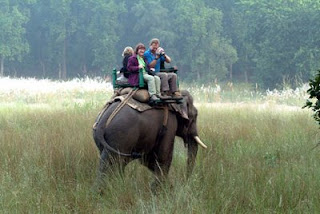
Regularly we get queries about elephant safaris in Kanha and Bandhavgarh. What used to be joy rides on Elephant back in these two parks in the afternoon have long been stopped. Now there is an interesting system called Tiger show on Elephant back, it has it's benefits and drawbacks. But before i delve into it, i would like to tell you how does it work.
In the morning, the domesticated elephants which belong to the forest department set out to track the Tiger. The expert mahouts who regularly track the Tigers normally succeed in finding the Tigers in the bush, it could be the Tigress with the cubs, or the cubs on a water hole, or a male Tiger on a kill. Once the Tigers are tracked by the Mahouts, they flash the message at the key camps, where the message is read by the drivers who are tracking the Tiger. They then take a token and report to the area where the Tiger is. Normally not more than 2-3 vehicles are allowed to be in the area where the Tiger is to avoid crowding and subsequent disturbance to the Tiger. Once your turn comes, you are asked on hop on to the Elephant and taken into the bush where the Tiger is. This is the closest you can get to a wild Tiger. You get an opportunity to click the Tiger and then you return to the area where your vehicle is standing. Your ride on the Elephant back normally lasts 3-5 minutes. But it is enough to get you good shots of the Tiger, if the tiger is obliging.
Now, the question arises, why is this system good. It is good, as tracking a Tiger in the huge forest is not always easy in a Jeep, so for a tourist who comes from few thousand miles this is a sure shot way of seeing a Tiger in the wild. Many a times the drivers and the naturalists are able to track the Tiger, but as Tiger is a highly territorial animal and also very elusive so it is extremely difficult to track the same. Also our Indian National Parks are not like the African parks which do not have so much of dense foliage, so while it is easy to track animals in Africa, in Indian National Parks it is challenging. Then the habits of tiger also do not help in easy tracking, unlike Lions, and Cheetahs which are found in a pride or a family, Tiger lives and hunts alone. No two big Tigers are seen together. Another important method used in Africa to track big game is use of wireless sets by the rangers in the Jeep, the same is not permitted in Indian National Parks. But please do not be disappointed, the fun is when despite all odds against you, the expert naturalists, drivers and Mahouts still track the Tigers. So, if you do not see the Tigers in your first drive, maybe second or third, please do not be disappointed, because you will forget everything once you spot your tiger in the Wild. In a normal three nights stay chances are extremely good of tracking Tigers from Jeeps itself. We do not guarentee Tiger sightings, as it is a Jungle out there, and one should realise the tiger sightings are a matter of calculated chance. But a 3 nights stay is a must at a Lodge which has good naturalists. Our naturalists and drivers at Chitvan, have had a 100% success rate in tracking Tigers from the Jeep.
Now, the reason why Tiger sightings from the Jeep are better than from Elephant back. A Tiger walking in front of your Jeep, or a one following your Jeep, is a far better photographic opportunity as a Tiger on the move is perhaps one of the most dynamic things you ever see in the forest. The angles that you get when taking a shot of a Tiger from the Jeep is much better, as it provides you with a depth of field which a Tiger photographer will die for. Though a Tiger is a Tiger, whether sitting or moving, but a moving Tiger is a much better sight compared to a relaxing Tiger.
So come, see for yourself these majestic, elusive, and most photographed mammals on the planet. Come once, as once you spot your first Tiger in the Wild, you will relate yourself with this extraordinary feline in a manner that you will come back again sooner than latter.
Cheers!
Tuesday, March 24, 2009
Kanha vs Bandhavgarh

Tiger sightings in Kanha are few compared to Bandhavgarh, but the quality of sightings in Kanha are far superior. When i say quality of sightings, there are various points i wish to state here. First and foremost, the sheer size of Kanha National park is huge, 5 times bigger then Bandhavgarh, which implies that the tourism pressure is not so intense here as in some other more popular Tiger reserves. Though there is rush to get inside the park, but once inside you practicaly do not encounter other vehicles for miles, and on many occassions than not you come across various animals all to yourself. There have been instances when our naturalists tracks a Tiger on the trail walking towards you, while you are wondering what to do, our driver is in complete control and is reversing cautiously, the Tiger totally oblivious to your presence keeps walking towards you, as he is perhaps patrolling his territory. Such sightings have been many in Kanha.
In a normal 3-4 nights stay, if you would do 4-5 safaris in the park, and you get one such sighting it will leave an indelible mark on your memory. Apart from Tigers, what you also see here and not in other parks is a healthy population of Bisons, Wild Dogs, Bara Singhas and many a times Leopards and Sloth Bears. So, if you wish to experience the thrill of being with a Tiger in the beautiful forests immortalised by Kipling, then this is your chance.
Subscribe to:
Posts (Atom)